Types of compressor plugins and when to use each
Most compressor types are named after the hardware circuit they started as. You don't need to know the electronics. You need to know how each one feels.
VCA
- Character
- Clean, punchy, precise
- Good on
- Drum bus, mix bus
- Well-known examples
- SSL-style bus compressors, Ableton Glue Compressor
FET
- Character
- Fast and aggressive, adds bite
- Good on
- Vocals, drums, bass
- Well-known examples
- 1176 emulations such as Universal Audio's and Waves CLA-76
Optical
- Character
- Slow, smooth, gentle
- Good on
- Vocals, bass, leveling
- Well-known examples
- LA-2A emulations such as Universal Audio's and Waves CLA-2A
Variable-mu
- Character
- Soft, thick, musical
- Good on
- Mix bus, mastering
- Well-known examples
- Fairchild 670 and Manley Variable Mu emulations
Digital
- Character
- Transparent, any shape you want
- Good on
- Anything
- Well-known examples
- FabFilter Pro-C, your DAW's stock compressor
Multiband
- Character
- Compresses frequency bands separately
- Good on
- Mastering, bass, synths
- Well-known examples
- Apex, FabFilter Pro-MB, Xfer OTT
Upward
- Character
- Lifts quiet detail instead of cutting peaks
- Good on
- Synths, vocal presence
- Well-known examples
- Apex
If you're not sure where to start, a clean digital compressor teaches you the most, because it does exactly what the controls say. The character types make more sense once you know what the basic controls do.
VCA and bus compressor plugins
A VCA compressor uses a voltage-controlled amplifier to turn the signal down, which makes it fast, clean and precise. Most bus compressor plugins are VCA designs modeled on the SSL console bus compressor: 2 to 4 dB of gain reduction on a drum or mix bus makes the parts move together without adding obvious color.
FET compressor plugins
A FET compressor uses a field-effect transistor as the gain element. The 1176 is the classic example, with attack times well under a millisecond and a forward, slightly gritty tone. That's why FET compressor plugins are a favorite on rap vocals, room mics and bass. Push one hard and the distortion becomes part of the sound.
Tube and optical compressor plugins
A tube compressor plugin emulates hardware where vacuum tubes do the gain reduction or color the output. Variable-mu units such as the Fairchild 670 compress more gently as the level rises and add thickness on a mix bus. The LA-2A pairs an optical cell with tube amplification, which gives it the slow, smooth leveling that suits vocals and bass.
How to use a compressor plugin
- Threshold: the level where compression starts. Lower it until the loud parts trigger gain reduction.
- Ratio: how hard it compresses above the threshold. 2:1 is gentle, 4:1 is firm, 8:1 and up is heavy.
- Attack: how quickly it clamps down. A slower attack lets the transient through, which keeps drums punchy.
- Release: how quickly it lets go. Too fast sounds grainy, too slow and the next note stays squashed.
- Makeup gain: brings the level back up so you compare at equal loudness, not louder versus quieter.
How hard to compress
Watch the gain reduction meter, not the knob positions. 2 to 3 dB on the loud moments is gentle control, 4 to 6 dB is firm and audible on most sources, and 10 dB or more is an effect. If a sound gets smaller or duller when you compress it, lower the ratio or slow the attack.
A limiter is a compressor with a very high ratio and a near-instant attack, built to hold a ceiling. Our compressor vs limiter guide explains when you need each.
Compressor settings: starting points by source
- Lead vocal: 3:1 to 4:1, attack 10 to 30 ms, release 50 to 150 ms, 3 to 6 dB of reduction on loud words.
- Drum bus: 2:1 to 4:1, attack around 30 ms so the hits get through, auto or medium release, 2 to 4 dB.
- Bass: 4:1, medium attack, release timed so it recovers before the next note.
- Mix bus: 2:1 or lower, slow attack, auto release, 1 to 2 dB at most.
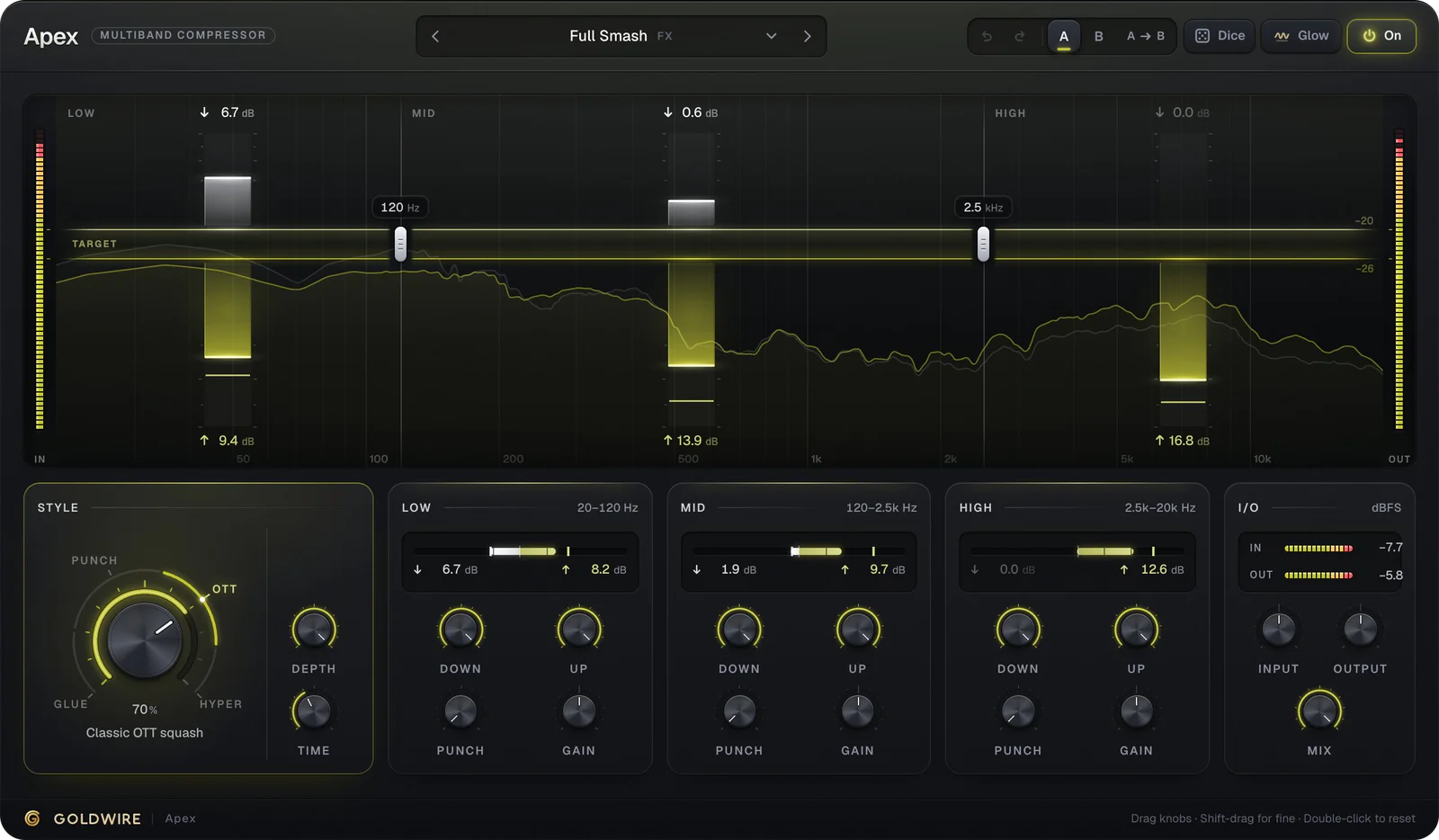
For drums, parallel compression is often better than squashing the bus itself: blend a heavily compressed copy under the dry signal. Apex's Drum Bus Pump preset does this with its Mix control at 50%, so the three-band squash sits underneath the untouched drums.
Style
Low
20–120 HzMid
120–2.5k HzHigh
2.5k–20k HzI/O
dBFSThe real plugin engine, running in your browser: same DSP code and presets as the VST3/AU/AAX.
Multiband and upward compression
A multiband compressor splits the signal into frequency bands and compresses each one on its own, so a boomy low end can be controlled without touching the vocal or the hi-hats. Upward compression works the other way round: instead of turning loud parts down, it lifts quiet parts up, which brings out detail and texture.
Apex does both across three bands, with one Depth knob that scales the whole effect from subtle glue to OTT-style smash. Read what is a multiband compressor for when to reach for one.
Sidechain compression and clipping
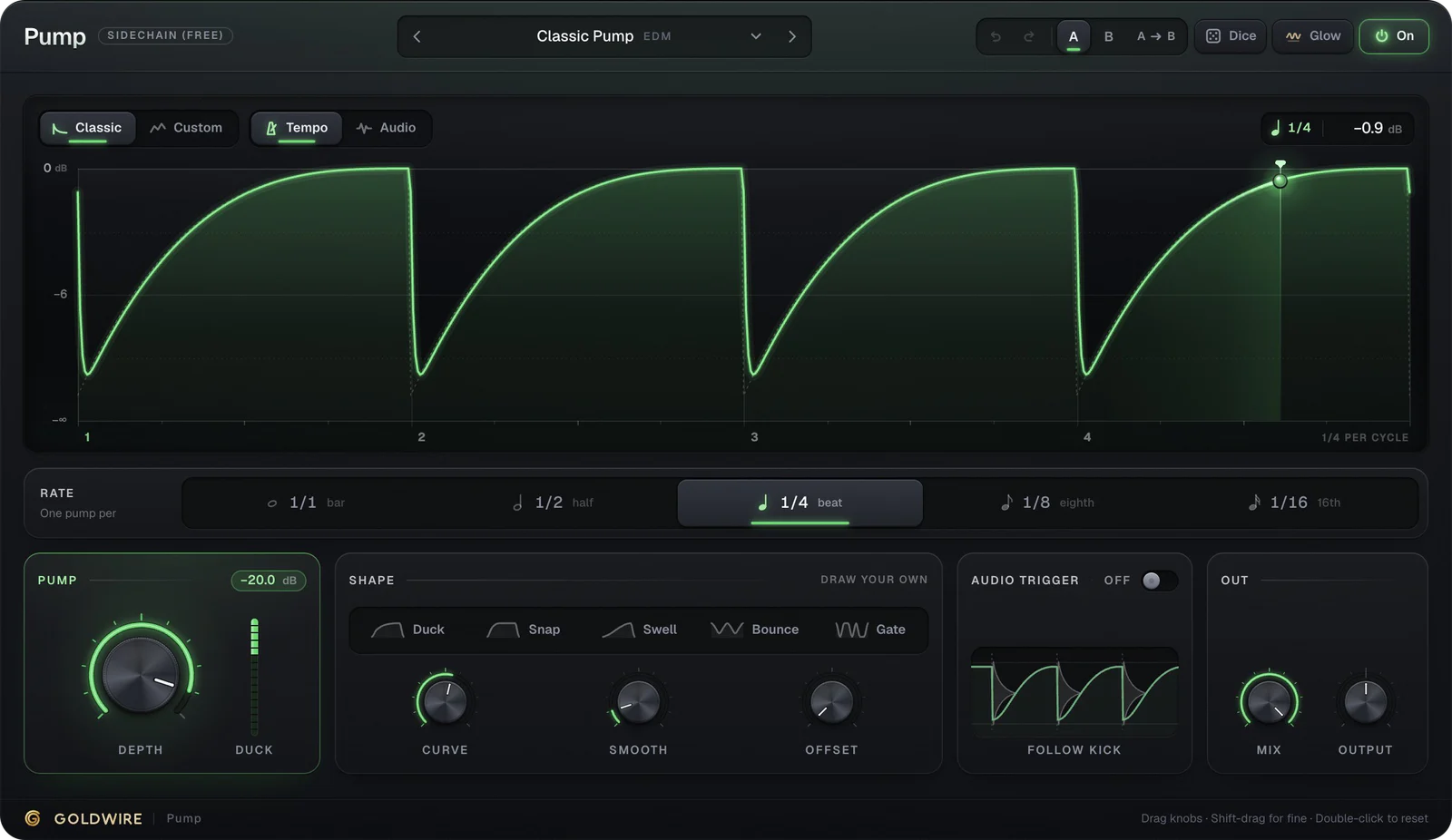
Sidechain compression lets one sound control the compressor on another, most often the kick ducking the bass or pads so the low end doesn't pile up. Our sidechain guide walks through the routing. If you only want the pumping effect, the free Pump follows your tempo and needs no routing at all.
Pump
Shape
Audio trigger
Out
The real plugin engine, running in your browser: same DSP code and presets as the VST3/AU/AAX.
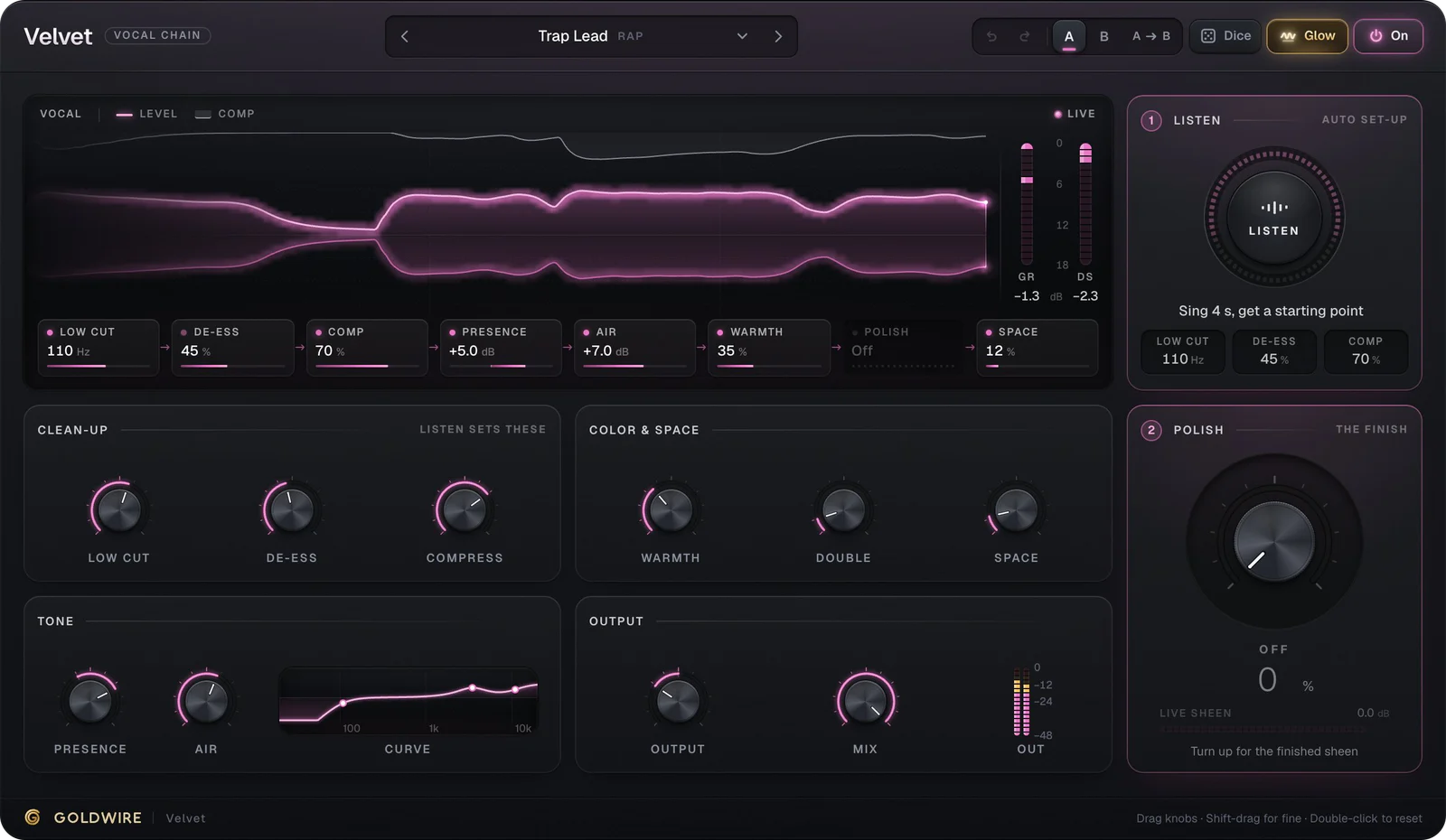
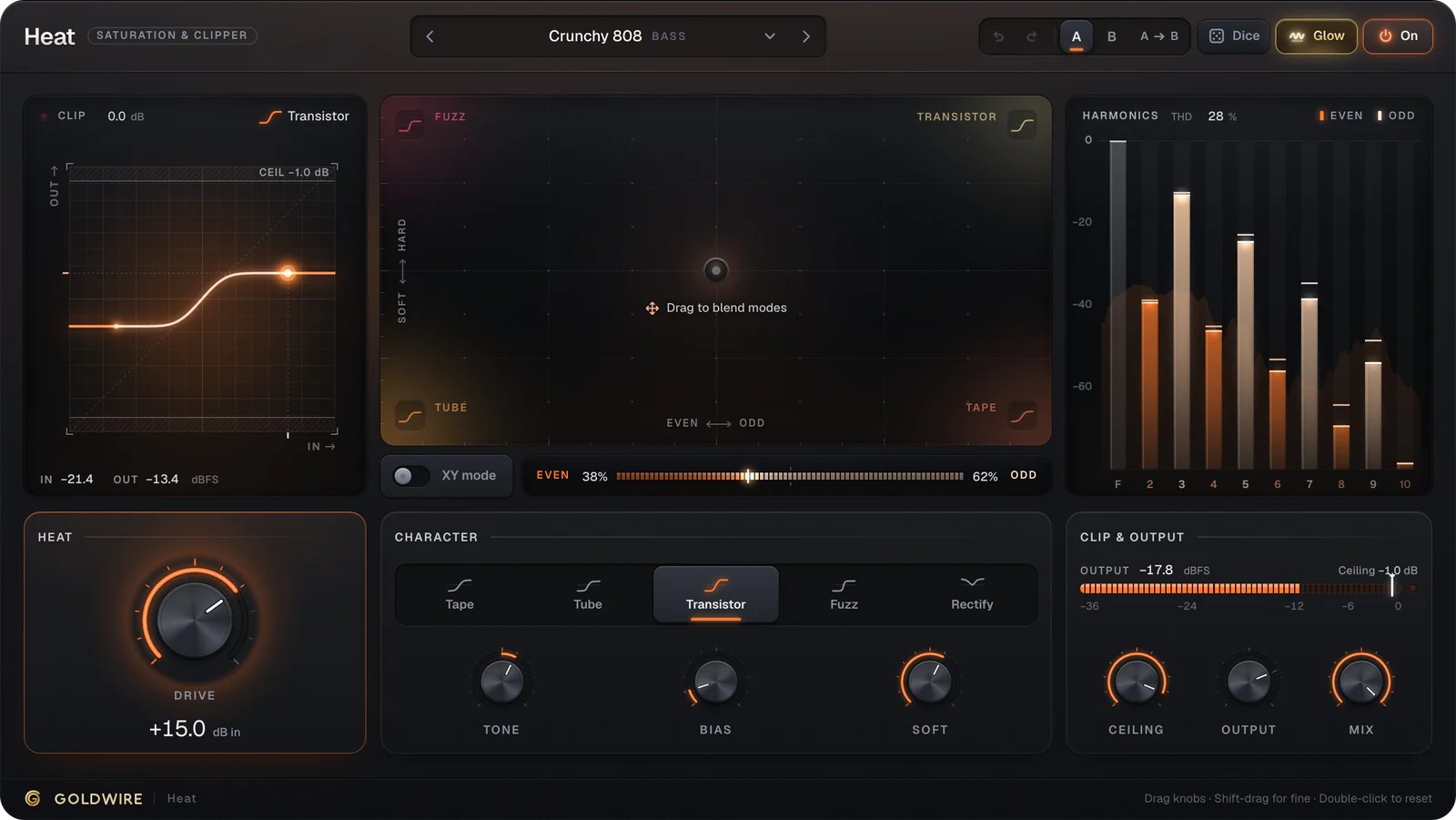
For peaks on drums and 808s, a soft clipper is sometimes a better tool than a fast compressor. Heat's clipper shaves the tips off transients so they hit harder at the same loudness. And for vocals, Velvet puts the compressor on one knob inside a full vocal chain.
Compressor plugins in Ableton, Pro Tools and FL Studio
Ableton Live: Compressor, Glue Compressor (developed with Cytomic and modeled on a classic console bus compressor) and Multiband Dynamics. See plugins for Ableton.
Pro Tools: Dyn3 Compressor/Limiter for clean work and BF-76, an 1176-style compressor. See plugins for Pro Tools.
FL Studio: Fruity Compressor, Fruity Limiter (which has a compressor mode) and Maximus for multiband. See plugins for FL Studio.
Logic Pro: the Compressor plugin includes several circuit types modeled on classic VCA, FET and optical designs, plus Multipressor for multiband.