The essential jazz progressions
ii–V–I
- In C major / C minor
- Dm7 – G7 – Cmaj7
- What it does
- The core cadence: tension (V7) resolving home
I–vi–ii–V
- In C major / C minor
- Cmaj7 – Am7 – Dm7 – G7
- What it does
- The classic turnaround, loops back to I
iii–vi–ii–V
- In C major / C minor
- Em7 – Am7 – Dm7 – G7
- What it does
- A longer chain of fifths, smoother and more sophisticated
iiø7–V7–i
- In C major / C minor
- Dm7♭5 – G7 – Cm7
- What it does
- Minor ii–V–i: darker, used in minor-key standards
I–IV–iii–vi
- In C major / C minor
- Cmaj7 – Fmaj7 – Em7 – Am7
- What it does
- Gentle, ballad-like movement
Rhythm changes (A section)
- In C major / C minor
- B♭–Gm7–Cm7–F7 ×2
- What it does
- Gershwin's 'I Got Rhythm' pattern, the basis of hundreds of tunes
How jazz pianists voice them
- 7ths everywhere: major 7 on I and IV, minor 7 on ii, iii and vi, dominant 7 on V. Triads alone sound like pop.
- Rootless voicings: the bass plays the root, so the piano plays 3–5–7–9 (for Dm9: F–A–C–E).
- Guide tones: the 3rd and 7th carry the harmony. From Dm7 to G7, the C (7th of Dm) falls a half step to B (3rd of G7). Move those voices smoothly and every progression sounds right.
- Walking bass: quarter notes, chord tones on the beat, a chromatic step into each new root.
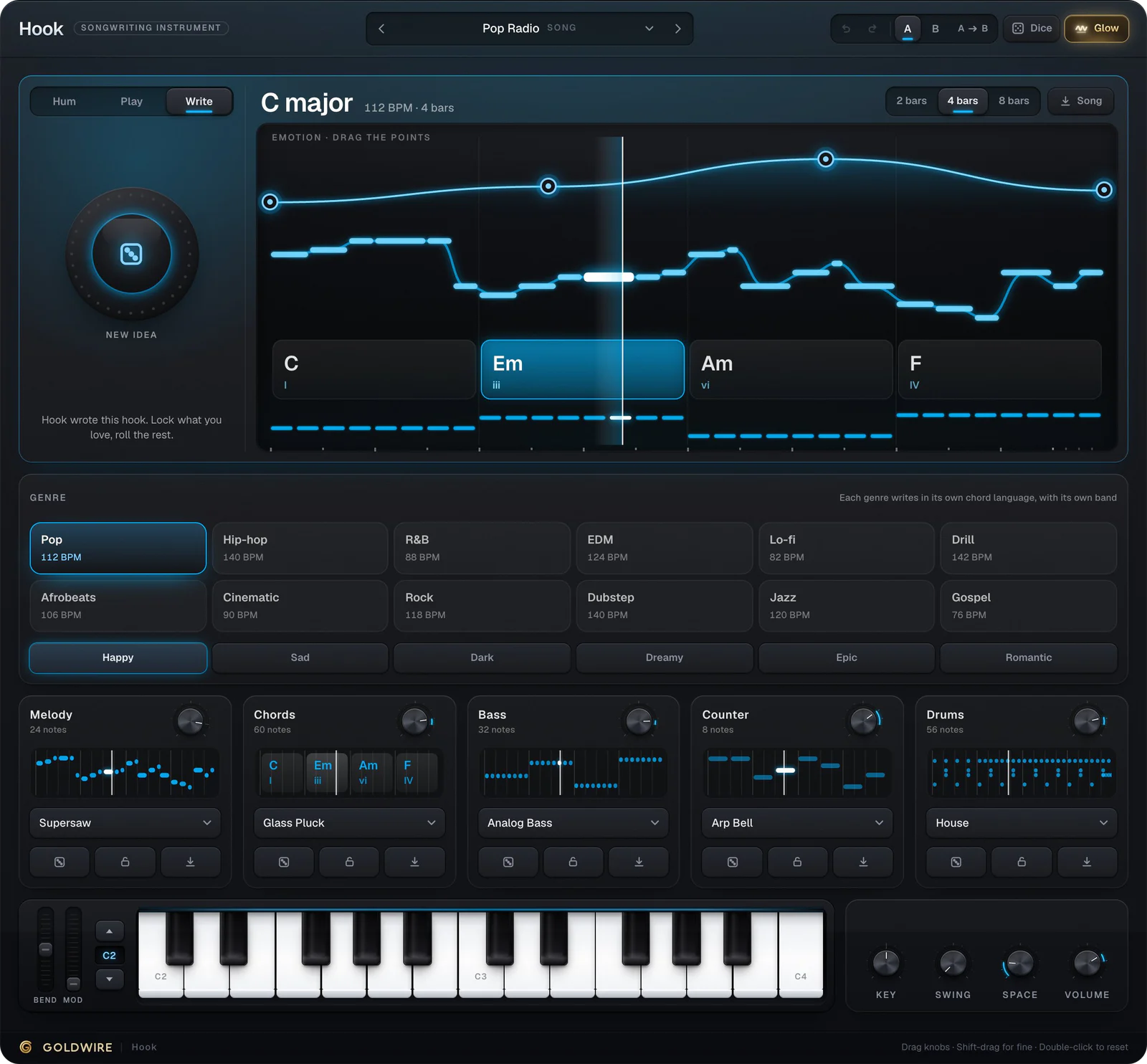
PlayYour keyboard: A–K · octave Z/X C4space
Hook
Previous presetNext preset
UndoRedoEditing ASwitch to BCopy A to B
Surprise me: a musical random variationGoldwire Glow: our subtle analog warmth, level-matchedNew idea
Hook wrote this hook. Lock what you love, roll the rest.
–
Export the whole song as MIDI
Emotion · drag the points
Genre
Melody0 notes
Level of the melody part.
Melody
New melodyLock: keep this part when you roll a new ideaExport melody as MIDI
Chords0 notes
Level of the chord part.
Chords
New chordsLock: keep this part when you roll a new ideaExport chords as MIDI
Bass0 notes
Level of the bass part.
Bass
New bassLock: keep this part when you roll a new ideaExport bass as MIDI
Counter0 notes
Level of the counter-melody.
Counter
New counterLock: keep this part when you roll a new ideaExport counter as MIDI
Drums0 notes
Level of the drums.
Drums
New drumsLock: keep this part when you roll a new ideaExport drums as MIDI
Bend
Mod
C2
C2
C3
C4
Moves the whole song up or down in semitones (drums stay put).
Key
Adds shuffle: off-beat 16ths land later.
Swing
Shared reverb on the whole band.
Space
Output level.
Volume
The real plugin engine, running in your browser: same DSP code and presets as the VST3/AU/AAX.
Play any of these in our free chord progression generator: pick Jazz, press play, then hum a melody and it re-harmonises around you.