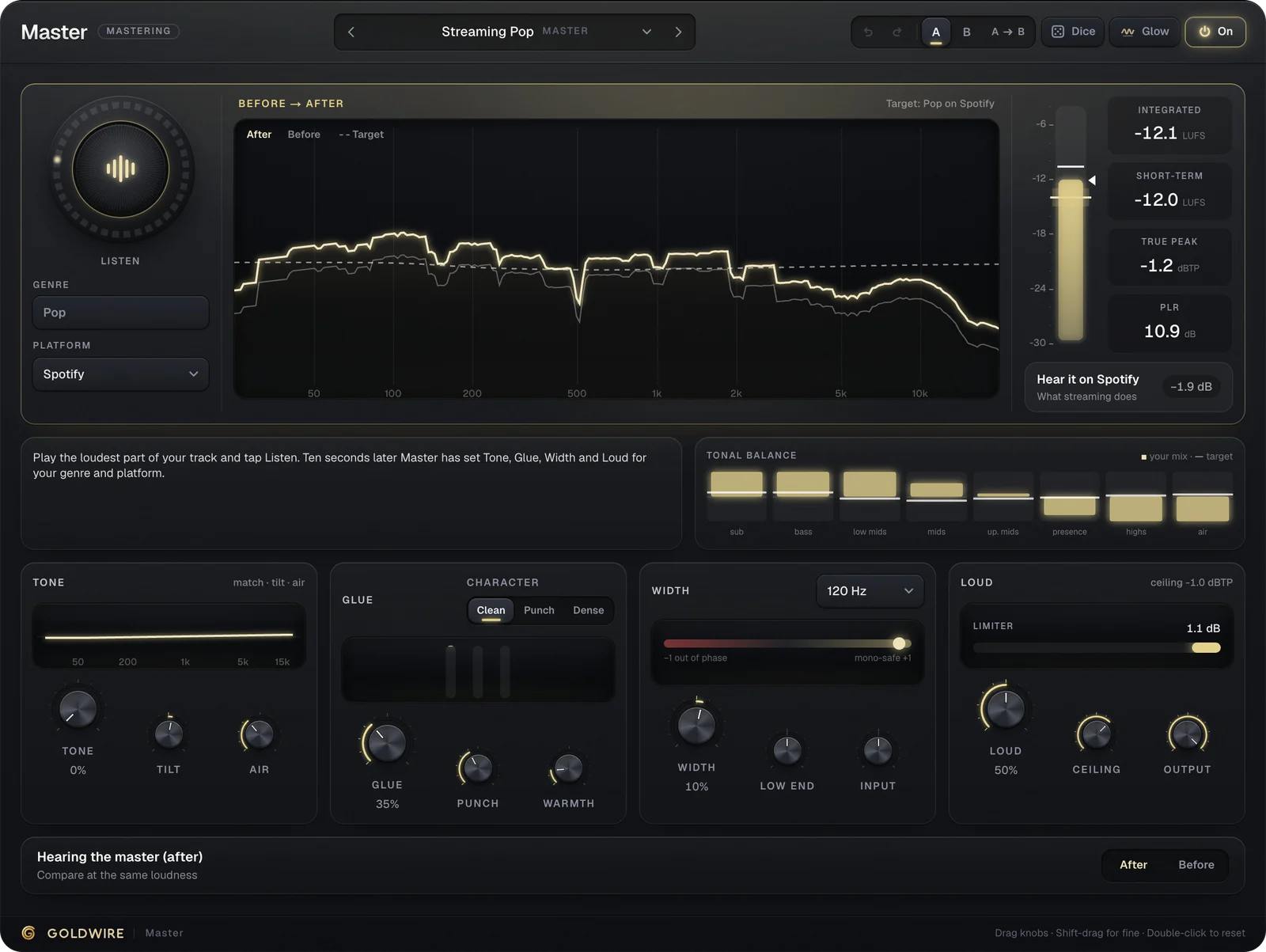
How the online mastering works
- Listen measures your mix: one-third-octave tonal balance, integrated loudness (ITU-R BS.1770-4), true peak, crest factor, stereo correlation and how mono the low end is.
- It compares that with the target for your genre (trap, pop, house, techno, lo-fi, rock, R&B, drum and bass, cinematic or acoustic) and sets Tone (a smooth match EQ), Glue (three-band compression), Width (with mono bass) and Loud (a true-peak limiter aimed at your platform's loudness).
- The same engine as the Master plugin renders the result in your browser. Nothing is uploaded.
- Compare Master and Your mix at matched loudness, and switch on Hear it on Spotify (or Apple Music, YouTube, Amazon, SoundCloud, club) to hear the platform's normalisation.
How loud should a master be?
Spotify
- Plays at
- −14 LUFS
- Turns quiet tracks up?
- Yes, up to −1 dBTP headroom
Apple Music
- Plays at
- −16 LUFS
- Turns quiet tracks up?
- Yes
YouTube
- Plays at
- −14 LUFS
- Turns quiet tracks up?
- No, only down
Amazon Music / Tidal
- Plays at
- −14 LUFS
- Turns quiet tracks up?
- Yes
SoundCloud
- Plays at
- about −14 LUFS
- Turns quiet tracks up?
- No
Club / DJ
- Plays at
- no normalisation
- Turns quiet tracks up?
- Masters usually −9 to −7 LUFS
Louder isn't better on streaming: a track mastered to −8 LUFS is simply turned down 6 dB on Spotify, and it keeps the squashed dynamics. Aim near the platform's level with true peaks under −1 dBTP.