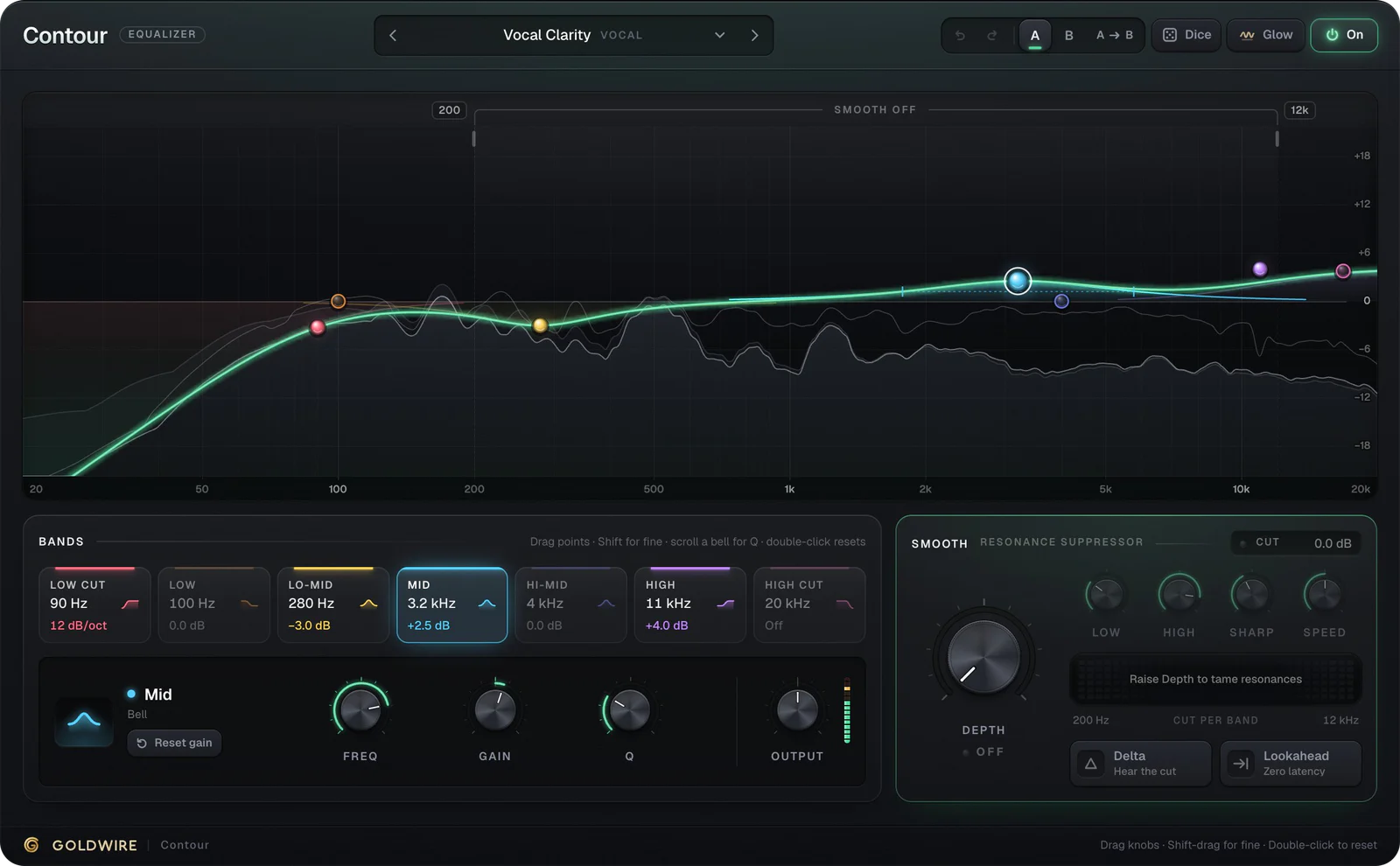
How to read an EQ frequency chart
The audible range runs from about 20 Hz to 20 kHz, and EQ charts split it into seven ranges. The low end (sub-bass and bass, 20–250 Hz) gives weight. The low mids (250–500 Hz) give body, and too much of them makes a mix muddy. The mids (500 Hz–2 kHz) are where instruments sound like themselves. The upper mids and presence (2–6 kHz) carry attack and clarity, and they turn harsh fast because the ear is most sensitive there. Brilliance (6–20 kHz) is sibilance, cymbals and air.
Solo, boost or cut: the fastest way to learn EQ
- Solo the range to hear what actually lives there. Soloing 250–500 Hz on a full mix makes the mud obvious in seconds.
- Boost +9 dB to find a problem: sweep a boost until something rings or honks, then cut there instead. This is the classic boost-and-sweep move.
- Cut −12 dB to hear what a range adds by taking it away. Cutting presence (4–6 kHz) shows how much of a vocal's clarity sits there.
- Hold: off while you listen, so you compare the EQ against the untouched sound at the same loudness.
Vocal EQ chart: where a voice lives
80–100 Hz and below
- What it does to a vocal
- Rumble, handling noise, plosives
- Usual move
- High-pass filter
200–400 Hz
- What it does to a vocal
- Body; mud and boxiness when stacked
- Usual move
- Cut 2–4 dB if it sounds muffled
800 Hz–1 kHz
- What it does to a vocal
- Nasal, honky tone
- Usual move
- Narrow cut if it sounds like a phone
2.5–4 kHz
- What it does to a vocal
- Intelligibility; harshness when pushed
- Usual move
- Cut narrow if harsh, boost wide for clarity
5–8 kHz
- What it does to a vocal
- Sibilance (s, t, sh)
- Usual move
- De-esser rather than static EQ
10–12 kHz and up
- What it does to a vocal
- Air and breath
- Usual move
- Gentle high shelf
For the full process, read how to EQ vocals, or let Velvet listen to the voice and set the clean-up, de-essing and air for you.
From the chart to your DAW
Once you know which range to fix, Contour shows it on a live analyzer while you drag the curve, so you see the build-up and hear the fix at the same time. On a finished mix, the Sculpt stage in Master is a dynamic EQ that only cuts a range like 2–4 kHz harshness when it actually spikes.